
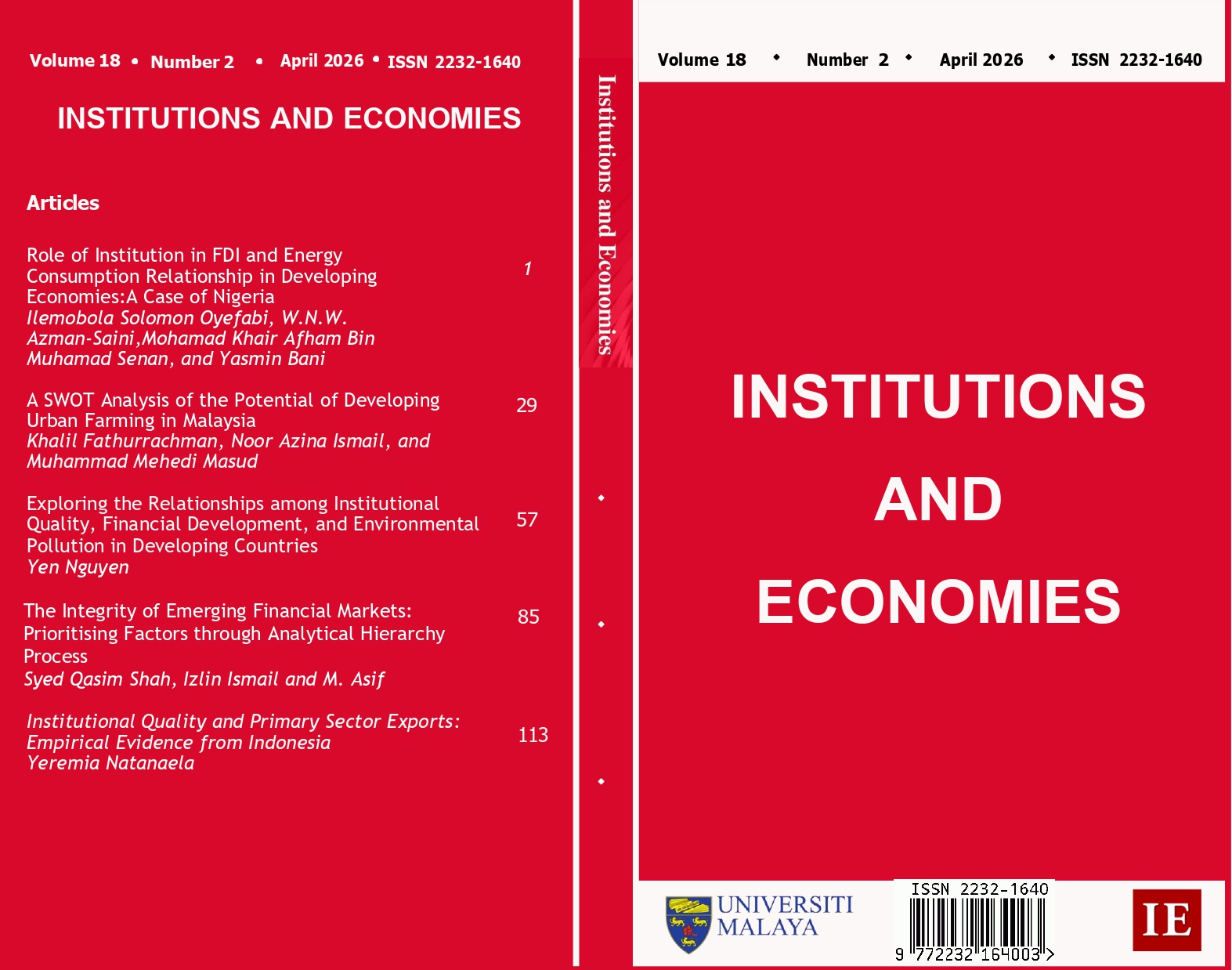
Role of Institution in FDI and Energy Consumption Relationship in Developing Economies: A Case of Nigeria
DOI:
https://doi.org/10.22452/IJIE.vol18no2.1Keywords:
Foreign direct investment, Energy consumption, Environmental Kuznets curve, Kernel-based regularised least squares, Dynamic ARDL simulationAbstract
This study examines the moderating effect of institutional quality on the
relationship between FDI and energy consumption in Nigeria from 1996 to 2022 using
the novel dynamic autoregressive distribution lag (dynardl) simulation model and Kernelbased
regularised least squares (KRLS). The results of the dynardl simulation show that
FDI increases energy consumption in the short run, but reduces energy consumption in
the long run. The results also validate the existence of an inverted U-shaped relationship
between FDI and energy consumption. More importantly, it was revealed that the
interactive relationship between FDI and institutional quality was found to reduce energy
consumption within the period under study. This indicates that while the benefits of
FDI are indisputable, they cannot be fully realised without the appropriate institutional
framework. Therefore, the institutional quality of the host country plays a pivotal role
in harnessing the absorptive capacity of FDI to effectively curtail energy consumption,
especially in the context of fossil fuels, and in promoting the adoption of energy-efficient
technologies.
Downloads
Published
Issue
Section
License
Submission of a manuscript implies: that the work described is original, has not been published before (except in the form of an abstract or as part of a published lecture, review, or thesis); that is not under consideration for publication elsewhere; that its publication has been approved by all co-authors, if any, as well as tacitly or explicitly by the responsible authorities at the institution where the work was carried out. Transfer of copyright to the University of Malaya becomes effective if and when the article is accepted for publication. The copyright covers the exclusive right to reproduce and distribute the article, including reprints, translations, photographic reproductions, microform, electronic form (offline and online) or other reproductions of similar nature.
An author may self-archive the English language version of his/her article on his/her own website and his/her institutions repository; however he/she may not use the publishers PDF version which is posted on www.ijie.um.edu.my. Furthermore, the author may only post his/her version, provided acknowledgement is given to the original source of publication and a link must be accompanied by the following text: The original publication is available at www.ijie.um.edu.my.
All articles published in this journal are protected by copyright, which covers the exclusive rights to reproduce and redistribute the article (e.g. as offprint), as well as all translation rights. No material published in this journal may be reproduced photographically or stored on microfilm, in electronic database, video disks, etc., without first obtaining written permission from the publishers. The use of general descriptive names, trade names, trademarks, etc., in this publication, even if not specifically identified, does not imply that these names are not protected by the relevant laws and regulations.
The copyright owners consent does not include copying for general distribution, promotion, new works, or resale. In these cases, specific written permission must first be obtained from the publishers.